PART 1
Five years after the divorce, Valeria Cortés boarded a first-class flight from Mexico City to Chicago with a single intention: to arrive, sign a contract, and return home to her children.
I didn’t expect to see him there.
Much less sitting two rows away, wearing the same impeccable suit, the same very expensive watch, and that look of a man accustomed to the world bowing down when he passed by.
Diego Santillán.
Her ex-husband.
The founder of Santillán Renovables, one of the most powerful clean energy companies in Mexico.
The man who once called her his genius, his partner, his wife.
And the same one who, 5 years ago, kicked her out of his life accusing her of betraying him.
Valeria felt like she couldn’t breathe, but she didn’t look down.
Diego did see her.
First he frowned, as if his presence was disrespectful.
Then he smiled.
A cold smile, one that doesn’t come from joy, but from a desire to hurt.
“No way,” he said, calmly approaching. “Valeria Cortés in first class. Life really does take unexpected turns.”
She closed the book she was holding.
—It also gives you a chance to avoid making a fool of yourself, Diego. Take advantage of it.
An elegant lady turned to look at them.
Diego seemed to enjoy it.
He showed his pass to the flight attendant, but instead of sitting where he was supposed to, he took the empty seat next to Valeria.
There were several places available.
He chose that one.
“That’s not your seat,” she said.
—I can change it. I still have some contacts.
Valeria looked out the window.
—Of course. You always confused influence with courage.
Diego let out a low laugh.
—And you always confused secrets with dignity.
The phrase hit him hard in the chest.
There it was again.
The old wound.
The accusation that had destroyed everything.
Five years ago, they were the perfect couple in Polanco.
Diego, the young businessman who appeared on magazine covers.
Valeria, the brilliant environmental engineer who had created some of the technology that built his empire.
Together they attended forums, dinners, openings, and charity events.
Everyone called them unstoppable.
Until one night, Diego found messages on Valeria’s cell phone.
“I need to see you tomorrow.”
“Don’t tell Diego anything until it’s confirmed.”
“If it comes back positive, we must act quickly.”
Diego didn’t ask.
He didn’t listen.
He didn’t wait.
He decided that she had a lover.
And when Valeria tried to explain, he had already called his lawyers.
In 3 months, the marriage was over.
Her mother-in-law, Doña Rebeca Santillán, made sure that Valeria’s surname was dragged through the mud with gossip.
That she had slept with a doctor.
That he only wanted money.
That Diego had escaped from a viper.
Valeria did not request a pension.
He didn’t ask for a house.
He did not ask for shares.
She left with two suitcases, a medical file, and a fear she could barely carry.
Now Diego looked at her as if he still believed that she had stayed crying for him all those years.
“You disappeared very quickly,” he said. “That always confirmed many things for me.”
—It confirmed what you wanted to believe.
—And what did you want me to believe?
Valeria looked at him for the first time.
—Not everything you don’t understand is a betrayal.
Diego clenched his jaw.
During the flight, he alternated between silences and cruel comments.
That Chicago wasn’t for everyone.
That she was probably going to desperately look for investors.
Whether it was curious to see her without the surname Santillán.
Valeria barely answered.
I had learned that some people don’t want dialogue.
They want an audience.
When the plane landed, she felt relieved.
She grabbed her bag, walked through the terminal, and headed out toward the private van area.
Diego was coming behind.
Not close enough to accompany her.
Close enough to see it.
Outside, the Chicago air was freezing.
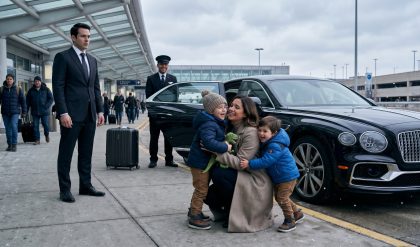
A black Bentley pulled up in front of them.
The driver got out quickly and opened the back door.
Then 3 small children jumped out of the car.
-Mother!
The scream made several people turn around.
The three of them ran straight towards Valeria.
One of them hung on to his waist.
Another one took her hand.
The youngest clung to her leg as if she had been gone for a whole year.
Valeria bent down, kissed them on the forehead, and smiled with tears in her eyes.
—My loves, I’ve arrived.
When she looked up, Diego was still motionless on the bench.
His face had lost all color.
Because all three children had Valeria’s eyes.
But they had Diego’s face.
The same dark hair.
The same crooked smile.
The same firm chin as the Santillán family.
Diego took a step, trembling.
—Valeria…
She hugged her children tighter.
And in her eyes he saw, for the first time, that the messages he used to destroy her had never been from a lover.
They were the beginning of a truth that he had just lost for 5 years.
PART 2
The older boy, Mateo, looked at Diego with curiosity.
She was 5 years old, wearing a blue jacket, and had that serious way of observing that Valeria recognized all too well.
—Mom, who is that man?
The question landed like a stone.
Diego opened his mouth, but said nothing.
For 5 years, Valeria had imagined that moment many times.
Sometimes Diego cried.
Sometimes he knelt down.
Sometimes he demanded answers as if he still had the right to kick down the door of his life.
But he never imagined that his own son would ask who his dad was in the middle of an airport.
Emiliano, the second one, hid behind Valeria.
Nicolás, the youngest by 4 minutes, raised his hand and waved without understanding anything.
—Is he your friend, Mommy?
Valeria swallowed.
—He’s someone I met a long time ago.
Diego closed his eyes, as if that phrase had hurt him more than a blow.
The Bentley driver approached.
—Mrs. Cortés, is everything alright?
Diego looked at the car, the driver, the suitcases, the well-dressed children.
Suddenly he understood that Valeria was not broken.
She was not alone.
He hadn’t spent 5 years begging to return to his world.
He had built one of his own.
“I need to talk to you,” Diego said, his voice hoarse.
Valeria adjusted Nicolás’s hat.
—Not in front of them.
—Then tell me when.
—Tomorrow. At 10. In my office.
Diego blinked.
—Your office?
Valeria looked at him without smiling.
—Yes, Diego. The women you humiliate sometimes continue working. And some even outperform your companies.
He didn’t wait for a reply.
He got into the Bentley with his children.
As the car moved forward, the children all started talking at the same time.
They asked if they had eaten pancakes.
Did Nicholas lose a dinosaur?
Ask if Mateo wanted to show her a drawing.
Valeria listened to them, but inside she was trembling.
Not because of Diego.
That’s what I came for.
That night, at her home in Lincoln Park, Valeria left 3 glasses of warm milk on the kitchen counter.
The house was full of life.
Toys in the living room.
Children’s books on the armchair.
Drawings stuck to the refrigerator.
It wasn’t the Polanco mansion that Diego had offered her as a cage.
It was his.
Purchased with patents, consulting, conferences and a company she founded while raising triplets with almost no sleep.
Winters no.
Santillán neither.
Cortés Biotech.
His name.
Your effort.
His silent revenge.
The next morning, Diego arrived on time at the Cortés Biotech headquarters.
The building was in downtown Chicago, with huge windows and an inconspicuous sign.
Upon entering, he saw photographs of treatment plants, international awards, government contracts, and environmental filtration prototypes.
On one wall was the name of Valeria Cortés as founder and scientific director.
Diego stared for too long.
Two years earlier, her own company had tried to license that technology without knowing that she was behind it.
When he entered the boardroom, he no longer had the cruel smile he’d had on the plane.
“I didn’t know you had done all this,” he said.
—You never asked.
He silently accepted the blow.
Valeria placed a folder on the table.
—Here’s what you should have read 5 years ago.
Diego sat down.
He opened the first page.
Birth certificates.
Mateo Daniel Cortés.
Emiliano Rafael Cortés.
Nicolás Diego Cortés.
His hand stopped on the third name.
—You named it after me.
Valeria looked towards the window.
—Not because of you. He was born making the same angry face as you.
Diego turned to the next page.
Ultrasound scans.
Medical reports.
High-risk multiple pregnancy.
High blood pressure.
Absolute rest.
Emails sent.
Letters received by lawyers.
3 attempts at formal notification.
Diego started reading faster.
Then slower.
As if each page were burying him.
—I never received this.
-I know.
He looked up.
—How can you know that?
Valeria took out another sheet of paper.
—Because your office responded that any attempt on my part to contact you would be considered post-divorce harassment.
Diego clenched his fists.
—I didn’t authorize that.
—I already figured as much.
—Valeria…
—The second letter was delivered to your office in Polanco. It was signed by your assistant, Mariana.
Diego froze.
—Mariana already worked with my mother.
-Exact.
Valeria pushed another document toward him.
—And the email with the medical studies was opened from an account managed by your legal team.
The silence became unbearable.
Diego covered his face with his hands.
But Valeria did not console him.
She wasn’t going to dry the tears of the man who left her alone when she was most afraid.
After a while, he asked:
—Were the text messages on your cell phone about the pregnancy?
Valeria opened a smaller folder.
—They belonged to Dr. Adrián Lozano.
Diego closed his eyes.
That name had been his poison.
The alleged lover.
The man for whom she caused scandals, broke glasses, and called her a liar in front of her mother.
“Adrián was a fertility specialist,” Valeria said. “He was reviewing some tests. I wanted to confirm it before telling you the news.”
Diego wasn’t breathing.
“We were going to have children,” she whispered.
—We already had them on their way.
The difference was brutal.
Diego got up, walked a few steps, and came back.
—My mother knew it.
It wasn’t a question.
It was the first truth he dared to face head-on.
Valeria took out a beige envelope.
—Your mother came to see me when I was 17 weeks old.
Diego turned pale.
—What did he do?
Valeria remembered Doña Rebeca entering her small apartment in Narvarte, dressed in white, perfumed, with that calm of rich people who believe they can buy even silence.
“If those babies are Diego’s, they’ll be a problem.”
“He is cleaning up his image.”
“I can give you 20,000,000 to disappear.”
Valeria said no.
Then Doña Rebeca smiled.
“If you come back, I’m going to take those children away from you with judges, experts, and newspapers. You don’t know who you’re messing with, little girl.”
“He offered me money,” Valeria said. “Then he threatened to fight for custody, accuse me of fraud, and destroy my reputation.”
Diego slammed his open hand on the table.
-Damn!
Valeria didn’t move.
—Don’t put on a show.
He looked at her, surprised.
—She’s my mother.
—And they are my children.
The phrase left him speechless.
“Our children,” she said carefully.
Valeria held his gaze.
—Biologically, yes.
That broke him.
But it was right that it hurt.
—I want to meet them.
-I know.
—I have the right.
Valeria stood up.
—Watch out, Diego.
He closed his mouth.
For the first time, he understood that he was not negotiating a company.
I was standing in front of a mother.
And that mother was no longer afraid of him.
“Sorry,” he said. “I didn’t mean it like that.”
—Yes, you wanted to. Speaking like the owner has always been your language.
Diego lowered his gaze.
—Then I’ll learn another one.
Valeria did not respond immediately.
Promises sound nice coming from guilty mouths.
But raising children is not just talk.
It’s a fever at 3 in the morning.
It’s paying for therapies.
It’s about holding tantrums.
It’s about answering soul-crushing questions.
“If you want to get close,” she said, “it will be with a child therapist, a lawyer, and rules set by me.”
Diego nodded.
—I accept.
—There will be no press.
—I accept.
—There will be no expensive gifts to buy affection.
—I accept.
—And your mother will never go near them.
Diego took 2 seconds.
Then he nodded.
—I accept.
The first visit was 3 weeks later in Valeria’s garden.
Diego arrived without bodyguards, without a driver, and without a flashy watch.
He was wearing jeans, a gray sweater, and had the face of a man who didn’t know what to do with his hands.
Matthew left first.
He looked at him as if he were evaluating a math problem.
Emiliano stuck to Valeria.
Nicholas brought a green dinosaur.
“Are you the man from the airport?” Nicolás asked.
Diego crouched down.
—Yes. My name is Diego.
Nicholas wrinkled his nose.
—I also have Diego in my name.
“I know,” he said, his voice breaking. “It’s a very important name.”
Matthew intervened.
—My mom said you were rude on the plane.
Valeria felt heat in her face.
Diego didn’t look at her.
—Your mom told the truth.
Mateo crossed his arms.
—Are you going to be rude here?
Diego swallowed hard.
—I’m going to try not to. And if I do, your mom can ask me to leave.
Mateo looked at Valeria.
She nodded.
Only then did the boy take a step closer.
It wasn’t forgiveness.
It was permission to begin.
The process was slow.
Diego attended therapy every week.
He signed agreements without arguing over every comma.
He ordered a review of the emails, letters, and divorce decisions.
She discovered that her mother, her assistant Mariana, and two lawyers had blocked Valeria’s attempts to warn her.
He also discovered that Doña Rebeca had fueled the rumor of the alleged infidelity to protect the Santillán surname.
The scandal broke when a former secretary handed over audio recordings.
In one, Doña Rebeca said:
“If Diego knows they are his, that woman will regain power. That’s not going to happen.”
Diego did not take the case to the press.
He didn’t use it to play the victim.
He sued the lawyers.
He fired Mariana.
And he cut off all contact with his mother.
Doña Rebeca tried to get closer to the children with toys, letters, and even an invitation to a hacienda in Valle de Bravo.
Everything was returned.
One afternoon he called Valeria’s office.
The assistant replied:
—Dr. Cortés does not receive calls from pregnant women who threaten her.
Valeria gave him a raise that same week.
Over time, Diego began to appear in small moments.
The school play.
The football match where Emiliano scored a goal in the wrong net.
Matthew’s fever.
A 6th birthday with chocolate cake and dinosaurs.
He didn’t arrive as a hero.
He arrived late to a life that was already functioning without him.
And that, at first, hurt him more than any punishment.
One day, Nicholas fell in the park and scraped his knee.
Diego carried it quickly.
“Dad, it hurts,” the boy said without thinking.
Everything went still.
Valeria felt her heart break and mend at the same time.
Diego hugged Nicolás carefully.
—Here I am, champ.
She didn’t cry in front of him.
But that night, after leaving the children asleep, he stayed at the door of the house.
“I didn’t deserve to hear that,” he said.
Valeria looked at him from the porch.
—Maybe not.
He nodded.
—But I’m going to take care of him.
—You can do that.
They were never the perfect couple again.
There was no new wedding.
There was no romantic cover.
There was no ending to the story.
The truth was more complicated.
Diego had destroyed the marriage out of pride, jealousy, and cowardice.
Valeria had survived without asking permission, but she had also learned to live with such a hard shell that it sometimes hurt to touch it.
The children didn’t need a fantasy.
They needed honest adults.
And that’s what they tried to be.
Sometimes Diego was wrong.
Sometimes I wanted to make too many decisions.
Sometimes Valeria would close doors before listening.
Then they went back to the same rule:
Children first.
The ego later.
Much later.
Five years later, Mateo found an old wedding photo in a box.
—Mom, did you two love each other?
Valeria looked at the picture.
She was wearing a white dress.
Diego smiling as if the future couldn’t touch him.
—Yes —he said—. We loved each other very much.
Emiliano asked:
—So why did they separate?
Diego, who was preparing hot chocolate in the kitchen, remained motionless.
Valeria did not lie.
—Because they hurt each other and didn’t listen in time.
Nicholas hugged his dinosaur.
—And now you can hear?
Diego showed up with 3 cups, a chocolate stain on his sleeve, and a humility he didn’t have before.
—Now we try every day—he said.
The children accepted that.
Because children understand attempts better than speeches.
That night, Valeria went out into the garden.
Diego was there, looking at the city lights.
“I wanted to humiliate you on that plane,” he said.
-I know.
—I thought you were alone. I thought you had lost.
Valeria took a deep breath.
—I wasn’t alone, Diego.
He closed his eyes.
—I already saw it.
The silence wasn’t awkward.
It was different.
A silence without war.
Diego did not recover the 5 years he lost.
He didn’t see the first steps.
He didn’t hear the first words.
He wasn’t there during the feverish nights or the scares.
But he understood that being a father doesn’t begin when blood proves you right.
It begins when you accept responsibility without trying to erase the damage you caused.
And Valeria understood something too.
Surviving betrayal doesn’t mean remaining cold forever.
It means opening the door only when you have the key.
Diego Santillán wanted to remind her in first class of everything she had lost.
But upon landing, 3 children got out of a Bentley shouting “mom” and showed her the truth.
The woman he thought he had destroyed was not waiting for his forgiveness.
He had built a complete life.
And that life no longer needed anyone’s surname to be worthwhile.