Five years had passed since I buried my wife, Isabelle. I thought I had learned to live with the grief, to raise our daughter, Sarah, alone, carrying memories that haunted every corner of our home. But nothing prepared me for the day I saw a woman who looked exactly like Isabelle walking down the aisle toward another man.
At first, I told myself it was my imagination. Grief plays cruel tricks, distorting shadows, twisting laughter into voices from the past, making empty rooms echo with footsteps. But this was no illusion. Her eyes—Isabelle’s eyes—looked straight into mine. The small scar above her left eyebrow, the one she got in our old kitchen years ago, confirmed it.
Sarah tugged my sleeve. “Daddy,” she whispered, trembling, “why are you crying?”
I couldn’t answer. Because the bride had turned toward me. The moment our eyes met, all the color drained from her face. Her bouquet slipped. Her lips parted. Then, in a faint voice I barely recognized, she whispered:
“Daniel?”
The church fell silent. Not quiet. Silent. The kind of silence that feels alive.
Thomas, the man she was about to marry, froze, confusion pulling his expression taut. The priest stopped mid-sentence. Guests leaned forward. Someone gasped.
Sarah’s small hand tightened around mine as I stepped toward her.
“Isabelle?” I said.
Her head shook slowly. “No,” she whispered. “I don’t know you.”
But I saw the recognition in her eyes before fear buried it.
“Daddy?” Sarah asked, looking up at me.
I nodded, unable to speak.

The bride pressed a trembling hand to her mouth. Thomas spun toward her. “Emily?”
Emily—the name printed on the wedding invitation. It felt like a lie written over a grave.
He tried to guide her, gently holding her arm, but she flinched. Every movement was cautious, every gesture measured.
I couldn’t stop staring. Five years of mourning, of raising Sarah alone, believing Isabelle dead, were gone in a heartbeat.
“She said my name,” I thought, heart hammering.
I moved faster. “Isabelle.”
She staggered as if my voice physically struck her. “I don’t… I don’t know.”
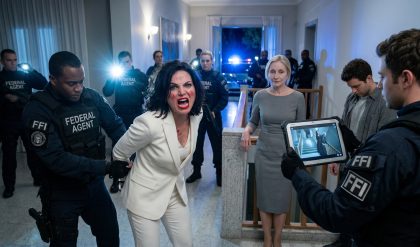
Thomas stepped between us. “That’s enough.”
I looked at him, really looked. Not confusion, but calculation. Cold, practiced, fast.
“Move,” I said.
“You are grieving,” Thomas said, voice controlled. “She is not your wife.”
“Then how does she know Sarah’s name?” I demanded.
The church grew silent again. The bride cried silently, a learned restraint that made her fear palpable.
Sarah walked forward. “Mommy?” she whispered.
I reached for her, but she moved first. Three small steps down the aisle.
The bride’s face crumpled. A soft, wounded sound escaped her as she dropped to her knees. Her wedding dress pooled around her like spilled moonlight.
She lifted a shaking hand. Sarah hesitated, then placed her tiny palm against hers. The bride sobbed. “Baby,” she whispered.
My knees nearly gave out.
Thomas grabbed her shoulder. “Emily, stop.”
She jerked away. Then an older woman stood from the second row on the bride’s side, silver dress, expression carved from stone.
“Thomas,” she said sharply. “End this now.”
The bride went pale. “Dr. Vale,” she whispered.

Thomas’s mother addressed the guests, explaining that Emily had health issues, though it barely made sense.
I took out my phone with trembling hands. Thomas noticed. “What are you doing?” he asked.
“Calling the police,” I said.
His face changed, just for a second. “Daniel, don’t.”
I dialed anyway. Before the call connected, the bride gasped. “Hospital… white room… cold lights… Thomas said—”
Thomas spun. “Emily.”
She flinched but kept moving. “He said Sarah was gone.”
My blood ran cold.
“What?” I whispered.
The bride’s eyes locked onto mine. “He told me my husband and baby died. He said I had no one.”
The church erupted. Guests stood. Someone shouted. Sarah cried.
Police arrived thirteen minutes later.
At the station, Isabelle sat wrapped in a gray blanket, holding Sarah tightly. Sarah refused to be separated, even for a moment. The detective placed a sealed evidence bag on the table. Inside was a folded document—a letter Isabelle had written three days before the accident.
“I don’t remember writing that,” Isabelle whispered.
The detective slid it toward us.
It read:
Daniel,
If anything happens to me, do not trust Thomas. I found records. My father’s company was moving money through his military contracts. Thomas knows. His mother knows. I was going to give everything to the authorities. If I disappear, protect Sarah. And Daniel… I am pregnant.
The room tilted.
“I am pregnant,” Isabelle whispered.
The detective showed us a photograph of a little boy, around four years old, with dark curls, serious eyes, and a small dimple in his chin—Sarah’s dimple.
Thomas and his mother had claimed the boy was adopted. His name was Noah.

Noah had unknowingly led me back to my wife. He had survived a stolen life, finding his way to the wedding.
Sarah approached him. “I’m Sarah,” she said. “I think you’re my brother.”
Noah hesitated, then ran into Isabelle’s arms, dropping the toy soldier he held.
For the first time in five years, grief loosened its grip on my heart.
Thomas later confessed at trial: false identity, private doctors, stolen child, and years of lies. When asked why he sent the wedding invitation, he smirked.
“I didn’t,” he said.
The invitation had been mailed by a four-year-old—Noah himself—following his mother’s whispers. He had unknowingly guided me back to my family.
I had not found Isabelle at the wedding. Our son had.
The truth was far stranger than anything I could have imagined.