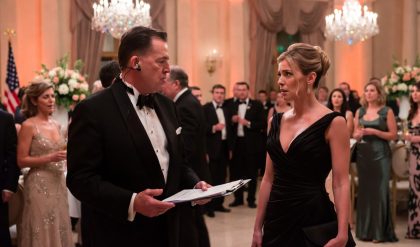
The heat hit like a weapon. It tore through Specialist Ava Cordero’s uniform instantly, soaking the fabric, clinging to her skin, burning deeper with every second she stood there. Her body screamed for her to step back, to cry out, to break—but she didn’t. She bit down so hard she tasted blood, forcing herself to stay upright.
The room went dead quiet. Fifty soldiers. Not a sound.
General Harris Thorne stood over her, the empty bucket dangling from his hand. His face was flushed, his breathing heavy, like he had just proven something. Like this was discipline. Like this was leadership.
“I bet your parents are ashamed of you,” he said, loud enough for every person in that hall to hear.
Ava’s hands trembled. Not from fear. From restraint.
“If they were here,” he continued, pacing slowly in front of her, “they would disown such a pathetic excuse for a soldier.”
A few people shifted in place. No one spoke. No one ever spoke when Thorne was like this.
Then he laughed. Cold. Loud. Cruel.
“Go ahead,” he said, turning back to her. “Call them. Let them see what a failure they raised.”
He thought it was a joke. He thought she had no one. He thought wrong.
Ava reached into her pocket slowly, ignoring the burning sensation spreading across her chest, and pulled out her phone. Her fingers shook—but her voice did not.
“Dad,” she said quietly. “The General wants to see you.”
Across the room, Thorne smirked wider.
“Oh, this is going to be good,” he muttered.
Five minutes. That was all it took. Five minutes for everything to change.
The double doors at the far end of the hall swung open with a heavy, echoing sound. And the moment they did, something in the air shifted.
Before that moment, Ava had already learned what it meant to survive under General Thorne. He did not believe in correction. He believed in breaking people. She had been transferred to his unit three months earlier, fresh out of training, still holding onto the belief that discipline came with purpose. That harshness had limits. That leadership meant responsibility.
She was wrong.
From day one, Thorne singled her out. It was not obvious at first. Just small things—extra drills, longer hours, harsher criticism. But it escalated quickly. He watched everything she did, waiting for mistakes, amplifying them when they came. And when they did not, he created them.
“Too slow.” “Too soft.” “Too emotional.” Every word was calculated. Every insult delivered with precision, designed not just to correct but to humiliate.
The others noticed. But no one intervened. Because Thorne had a reputation. Not just within the base but beyond it. He was decorated, respected, feared. His record was spotless. His authority, absolute. No one questioned him.
Until Ava.
It happened during a routine inspection. He accused her of failing protocol—something she knew she had not done. Something she had double-checked, triple-checked.
“I followed procedure exactly,” she said.
The room went still. You did not talk back to Thorne.
His eyes narrowed slightly. Not angry. Curious.
“You are calling me wrong?” he asked quietly.
“I am saying the report is inaccurate, sir.”
That was the moment everything shifted. From that day forward, it was not just discipline. It was personal. The drills became harsher. The comments more cutting. The punishments more public. He wanted her to break. And every day she refused, it made him push harder.
Ava thought she could endure it. She thought if she stayed strong, stayed silent, stayed focused, it would pass. But men like Thorne do not stop when they are resisted. They escalate.
That morning, she had been late by two minutes. Two minutes. Not because she was careless but because she had been helping another soldier who collapsed during early drills. She stayed back to get him medical attention.
Thorne did not care.
“Excuses,” he said flatly.
“I was assisting—”
“Silence.”
The entire unit was called into the assembly hall. Ava knew something was coming. But she did not expect that. She did not expect him to grab a bucket of cleaning water. Did not expect him to walk toward her slowly, deliberately. Did not expect the words: “You will learn respect.”
And then the heat. The shock. The silence.
What she did not expect most of all was what would happen next. Because when she made that call, when she said those simple words, everything she had endured—every insult, every punishment, every moment of forced silence—was about to collide with something Thorne never saw coming.
And as the doors opened, she realized something else. She was not trembling anymore. He was.
The doors did not just open. They commanded attention. The sound alone cut through the silence like a blade, drawing every eye in the room toward the entrance. Fifty soldiers turned in unison, their rigid discipline cracking just enough to reveal curiosity and something else: tension.
An older couple stepped inside. They did not rush. They did not speak. But the way they moved—calm, controlled, deliberate—shifted the energy in the room instantly. It was subtle, almost invisible, but undeniable. Even the air felt heavier.
Ava’s mother stayed slightly behind. Her father walked forward. No uniform. No rank displayed. Just presence. And it was enough.
General Thorne turned, already preparing to speak, already wearing that same cruel half-smile he used on everyone who walked into his space uninvited. But the moment his eyes landed on Ava’s father, everything collapsed.
The smile vanished. Not faded. Vanished. Color drained from his face so fast it was almost shocking. His posture stiffened, then faltered. His hand, still gripping the empty bucket, twitched before slowly lowering. For the first time since Ava had met him, General Thorne looked uncertain.
“General Thorne,” her father said, his voice calm, low, and dangerously controlled. “It has been a long time.”
Silence. Absolute silence.
Thorne blinked. Once. Twice. As if trying to process what he was seeing. Then his lips parted slightly.
“Colonel… Brennan?” he whispered.
The name echoed through the hall like a shockwave. A few soldiers exchanged quick glances. Others looked at Ava. At him. Back at her again.
Thorne took a step back. Just one. But it said everything. His eyes dropped—to her chest. To the soaked fabric. To the angry red burns spreading across her skin. Then they snapped back to her father. And in that moment, something broke. Not physically. Psychologically. Fear. Real fear.
“I… did not know,” Thorne said quickly, his voice no longer steady. “I had no idea she was—”
“My daughter?” her father finished calmly.
Thorne swallowed. “Yes… sir.”
The shift was complete. The man who had screamed, mocked, humiliated was now choosing his words carefully. Measuring every tone. Every movement.
Ava’s father stepped closer. Not aggressively. Not loudly. But with absolute control.
“I watched you,” he said. “For months.”
Thorne froze.
“I asked for reports,” her father continued. “I reviewed evaluations. I saw the patterns.”
The room seemed to shrink.
“You did not break her,” he said quietly. A pause. “You exposed yourself.”
Thorne shook his head quickly. “No, sir, it is not—”
“Enough.”
The word was not loud. But it hit harder than anything Thorne had said that morning.
Ava’s father turned slightly, gesturing toward her. “Look at her.”
Thorne hesitated. Then slowly did.
“She stood,” her father said, “while you tried to humiliate her.” Another step forward. “She stayed silent while you tried to break her.” Another. “And now you are going to answer for it.”
The room held its breath. Thorne opened his mouth—but no words came out.
Because in that exact moment, another set of doors opened behind them. Louder. Sharper. More final. And when everyone turned, what walked in made even Ava’s father pause.
Three officers. High-ranking. Flanked by military police. And the one in front did not look at Thorne. Did not look at Ava’s father. He looked at Ava.
Then said something that shattered everything they thought they understood.
“Specialist Cordero,” he said clearly. “You are not supposed to be here.”
The silence that followed was not fear. It was confusion. And the way Ava’s father’s expression changed—for the first time—told her something was very, very wrong.
Because whatever Thorne had done, whatever punishment was coming, whatever truth was about to be revealed, was only a fraction of the story.
And as the officer took one step closer, reaching into his coat, Ava realized she was not the only one hiding something. And neither was her father.