Three years ago, I was twenty-six years old, down to my last twelve dollars, and walking home through the rain after giving away the only meal I had to a stranger.
At the time, I spent that entire miserable walk wondering whether I had just made the dumbest decision of my life.
By the following morning, I had my answer.
When Everything Fell Apart
The year everything went wrong, it went wrong all at once.
I lost my job at a design firm in March. I lost my apartment in June. Somewhere in between, I lost my boyfriend too.
He left the way people sometimes leave when they realize the version of you they fell in love with no longer exists.
I didn’t exactly blame him.
But I didn’t forgive him, either.
With nowhere else to go, I rented a tiny room in a shared house on the edge of the city—a place where the heating worked only when it felt like it, and where nobody spoke to each other in the kitchen.
For the next three years, I survived on temporary jobs: filing documents, entering data, answering phones, and taking whatever work I could find.
My dream had always been architecture.
I had been halfway through my degree when the money ran out. For years, I kept telling myself I would return someday.
But dreams become harder to believe when you’re checking your bank account before deciding whether you can afford a bus ride.
On the afternoon this story began, my account balance was twelve dollars.
The Man on the Sidewalk
I had just finished a two-day filing assignment downtown.
Exhausted and hungry, I stopped at a deli and bought a turkey-and-swiss sandwich on sourdough. It cost a little over four dollars.
My plan was simple.
Eat half now.
Save half for later.
That kind of math had become second nature.
A block from the bus stop, I noticed an elderly man sitting against the wall of a closed pharmacy.
There was a paper cup beside him.
But it wasn’t the cup that caught my attention.
It was his face.
He wasn’t staring at the ground like so many people who wished they could disappear.
Instead, he was watching the crowds pass by with a quiet sadness.
Not anger.
Not bitterness.
Just sadness.
A man who understood exactly how invisible he had become.
Our eyes met.
And I stopped walking.
For a moment, I stood there holding my sandwich while people streamed around me.
Then I walked over and crouched beside him.
“Have you eaten today?” I asked.
He studied me carefully.
“I’ll manage,” he replied.
I held out the sandwich.
“Here.”
He looked from the food back to my face.
“Are you sure?”
“Yes.”
Slowly, he accepted it.
“Thank you,” he said quietly. “I truly mean that.”
“It’s okay,” I told him.
Then I stood up and walked away.
Only then did I remember something important.
The money I’d spent on that sandwich was also my bus fare home.
So I walked.
Five miles.
In the rain.

The Long Walk Home
My shoes were soaked before I finished the first mile.
By the second mile, I was hungry.
By the third, miserable.
By the fourth, I was questioning every life choice that had led me there.
A very honest conversation began in my head.
Was kindness a luxury I simply couldn’t afford anymore?
The math wasn’t encouraging.
By the time I reached the shared house, I was cold, exhausted, and starving.
There was no dinner waiting for me.
I went straight to bed and stared at the ceiling for hours.
What exactly did I think I was accomplishing?
I eventually fell asleep without an answer.
The next morning, I opened the front door and nearly convinced myself I was dreaming.
An envelope sat on the doormat.
It was thick, cream-colored, and addressed simply to me.
Sarah.
No return address.
Just my name written in elegant, old-fashioned handwriting.
I sat on the front steps and opened it.
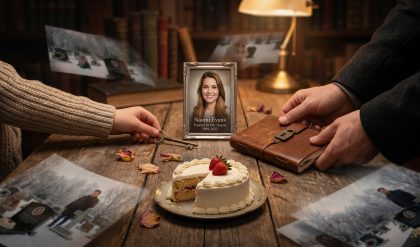
Inside was a heavy brass key.
A printed address.
And a handwritten note.
It read:
“Thank you for seeing a human being when everyone else saw a burden. Please come. There is something I would like to offer you.
Arthur.”
I read the note three times.
My first thought was that it had been delivered to the wrong house.
My second thought was that I should probably be concerned about a stranger knowing where I lived.
But beneath those concerns was a strange certainty.
The old man and this letter were connected.
I searched the name online.
The results appeared instantly.
And I sat frozen on those steps.
Arthur wasn’t just some stranger.
He was one of the wealthiest men in the state.
The Truth About Arthur
The address led me to a gated estate outside the city.
Arthur was waiting at the front entrance.
He looked healthier than he had on the sidewalk, but there was no mistaking him.
It was the same man.
The same eyes.
The same sadness.
“You came,” he said.
“I almost didn’t.”
A small smile crossed his face.
“Good,” he replied. “Come inside.”
Over tea, Arthur finally explained everything.
His wife had died fourteen months earlier.
After her death, he had watched his children fight over money, influence, and inheritance.
The experience shattered his faith in people.
In his grief, he began leaving his estate and spending time anonymously in the city.
Not as a test.
Not as an experiment.
Simply to observe.
To remind himself what ordinary people were like.
“I sat on seventeen different street corners over the past year,” he told me.
“I watched thousands of people walk by.”
Then he looked directly at me.
“And yesterday, you crouched down to my level before offering help.”
I frowned.
“It sounds small.”
“It isn’t,” he said.
For a moment, neither of us spoke.
Then he added quietly:
“You saw me.”
A New Beginning
Before I left that day, Arthur made me an offer.
He wanted me to manage one of his charitable foundations.
The organization provided educational opportunities to students whose studies had been interrupted by financial hardship.
People like me.
He didn’t offer the position out of pity.
He offered it because he believed my experiences gave me insight others lacked.
And for the first time in years, someone saw value in what I had survived.
I accepted.
The work changed my life.
For the first time in years, I felt useful.
Purposeful.
Hopeful.
But the new beginning would soon uncover something neither Arthur nor I expected.
Something buried decades in the past.

Arthur’s Son
Arthur’s son, Richard, appeared during my second week.
Unlike his father, Richard possessed none of Arthur’s warmth.
He walked into the office with the confidence of someone who assumed ownership of every room he entered.
“So you’re Sarah,” he said.
There was something dismissive in his tone.
I smiled politely.
“It’s nice to meet you.”
“My father has been making a lot of emotional decisions lately.”
The implication was obvious.
I wasn’t welcome.
Over the following weeks, Richard kept returning.
Sometimes he asked about budgets.
Other times he asked questions about me.
Too many questions.
How had Arthur found me?
Did I know who he was?
What had I been doing before this job?
At first, I thought he simply distrusted me.
Later, I realized he had another reason.
The Folder
One month later, while organizing decades of foundation records, I found a folder bearing my last name.
I assumed it was coincidence.
Then I opened it.
Inside was my father’s full name.
My father had died in a workplace accident when I was six.
Growing up, I knew very little about the circumstances.
Within hours, everything changed.
The documents revealed that my father had worked in Arthur’s company twenty years earlier.
More importantly, he had discovered evidence of major financial fraud.
Millions of dollars had disappeared through shell accounts.
And he had been preparing to report it.
Three weeks before he could do so, he died.
The accounts connected to the fraud belonged to Richard.
The Investigation
I took the folder directly to Arthur.
He read every page in silence.
When he finished, he looked at me with genuine sorrow.
“I’m sorry about your father.”
“I know you didn’t know.”
“That doesn’t make it hurt any less.”
Arthur immediately launched an independent investigation.
Outside auditors were hired.
Attorneys reviewed decades of records.
The deeper they dug, the more evidence surfaced.
Every trail led back to Richard.
For me, however, the most meaningful discoveries weren’t about him.
They were about my father.
I found performance reviews.
Letters from coworkers.
Handwritten notes.
One described him as “painfully honest.”
Another mentioned that he refused to sign anything until every number had been verified.
For the first time in my life, I truly understood who my father had been.
And I couldn’t have been more proud.
Justice
Eventually, Richard realized what was happening.
One afternoon, he entered my office and closed the door behind him.
“You’ve been very busy,” he said.
“I’m doing my job.”
“That’s not what I meant.”
Then he smiled.
“My father has always had a weakness for rescue projects.”
The threat was subtle.
Which made it more dangerous.
That evening, I told Arthur.
He listened quietly.
“I used to think I knew my children completely,” he admitted.
“And now?”
“Now I think I only knew them when circumstances were favorable.”
Six weeks later, the final report arrived.
The fraud was real.
It stretched back years.
And hidden within the evidence was confirmation that my father had uncovered it before his death.
There was no evidence that Richard caused the accident.
But there was evidence that he benefited from the investigation ending when it did.
Arthur turned everything over to regulators.
Months later, warrants were issued.
Charges were filed.
Richard was arrested.
The Lesson I Never Expected
I watched the news coverage from the foundation office.
Arthur didn’t.
He remained in his office, staring out at the city.
When I checked on him, he spoke without turning around.
“I keep wondering where I failed.”
I didn’t know how to answer.
Because some tragedies aren’t failures of parenting.
They’re failures of choice.
And some truths arrive so late that nobody walks away unchanged.
Sometimes I still think about that rainy afternoon.
I think about the sandwich.
The five-mile walk home.
The hunger.
The doubt.
I think about how close I came to walking past that elderly man and continuing on with my day.
If I had, none of what followed would have happened.
I wouldn’t have met Arthur.
I wouldn’t have learned the truth about my father.
I wouldn’t have found meaningful work.
And I wouldn’t have discovered that a single act of kindness—especially when it’s difficult—can change far more lives than we ever imagine.
All because one day, when I had almost nothing, I chose to share what little I had.
Note: This story is a work of fiction inspired by real events. Names, characters, and details have been altered. Any resemblance is coincidental. The author and publisher disclaim accuracy, liability, and responsibility for interpretations or reliance. All images are for illustration purposes only.