Rachel’s smile grew, but it was not the kind of smile that came from vanity. It was the kind of smile a woman wore when she had finally decided to stop shrinking herself for people who never deserved that sacrifice. For five years, she had hidden behind thick glasses and shapeless clothes because invisibility had kept her safe, but now the same armor had become a cage someone else had dared to mock.
“I’m going to attend the gala,” Rachel said, her voice calm enough to frighten Moren. “And I’m going to let Elijah Wescott discover something he should have learned years ago.”
Moren leaned closer. “Which is?”
“That a woman does not become valuable only when a man finds her beautiful,” Rachel replied. “But since he wants to measure me by appearance, I’ll let him lose by his own rules first.”
Moren stared at her for one long second, then slowly began to grin. “Oh, this is going to be dangerous.”
“No,” Rachel said softly. “It’s going to be educational.”
The next two days passed with strange quietness. Rachel continued working as usual, answering Elijah’s calls, correcting his reports, organizing his investor meeting notes, and saving him twice from mistakes that would have embarrassed him in front of the board. She did not mention the gala. She did not mention the bet. She did not even look at him differently.
That bothered Elijah more than he expected.
He had no idea she had heard him. Still, something about Rachel’s silence felt sharper than usual. She moved around his office with the same efficiency, but there was a distance in her politeness that made him feel like a man standing outside a locked door he used to own.
On Friday afternoon, Elijah stepped out of his office and adjusted his cufflinks. “Rachel, I need the revised donor list before five.”
“It’s already in your inbox,” she said without looking up.
He paused. “The seating chart?”
“Updated and sent to the event coordinator.”
“The keynote notes?”
“Printed, placed in your black folder, and backed up on your tablet.”
He blinked. “Right.”
Rachel finally looked up through her thick glasses. “Will there be anything else, Mr. Wescott?”
For some reason, the formal tone irritated him. He had always appreciated how invisible Rachel was, how she never demanded attention, never created drama, never flirted like other assistants had. She was reliable, plain, and quiet. But now, for the first time, he noticed that her eyes behind the glasses were not dull at all. They were steady, and they made him feel judged.
“No,” he said. “That will be all.”
Rachel nodded and returned to her work.
At exactly five-thirty, she shut down her computer, placed her files in order, and walked to the elevator with her old canvas tote over her shoulder. Elijah saw her go and felt a flicker of curiosity. He wondered what someone like Rachel did on a Friday night. Laundry, maybe. Takeout. Some boring TV show. The thought should not have bothered him, but it did.
He did not know that three blocks away, inside Moren’s apartment, Rachel Appleton was about to become visible for the first time in years.
Moren had turned her living room into a battlefield of beauty supplies, garment bags, shoes, jewelry, and coffee cups. Rachel stood in the middle of it all, looking overwhelmed. Her hair, usually twisted into a severe knot, fell past her shoulders in thick chestnut waves. Without the glasses, her face looked softer, more open, and startlingly elegant.
Moren circled her like a stylist preparing a queen for war. “I still can’t believe you’ve been hiding all this.”
Rachel folded her arms. “This is exactly why I hid it.”
Moren’s excitement faded slightly. “Because of what happened before?”
Rachel looked toward the window, where Manhattan glittered beneath the evening sky. “At my first job after college, my manager kept telling me I should smile more. Then he started asking me to stay late. Then he touched my waist at the copy machine and said pretty girls shouldn’t act so cold.”
Moren’s expression hardened.
Rachel continued quietly. “When I reported him, HR told me I had probably misunderstood. Two weeks later, I was transferred to a dead-end department. So I learned. Men leave invisible women alone.”
Moren reached for her hand. “I’m sorry.”
Rachel squeezed back once. “I’m not hiding tonight. But I’m not doing this because Elijah hurt my vanity. I’m doing it because he needs to understand that women do not owe men beauty to earn respect.”
Moren nodded. “Then let’s make him understand very loudly.”
The dress was deep emerald satin, elegant rather than revealing, with a clean neckline and a long, graceful silhouette that moved like water when Rachel walked. Moren had borrowed it from a designer friend who owed her a favor. The color made Rachel’s eyes look brighter, and the cut showed a confidence she had buried beneath baggy sweaters for years.
Moren added delicate gold earrings, simple heels, and light makeup that enhanced Rachel’s features without turning her into someone else. When Rachel finally stood before the mirror, she almost did not recognize herself. Not because she looked beautiful, though she did. Because she looked unafraid.
Moren stood behind her, smiling. “There she is.”
Rachel touched the edge of the mirror. “No. She was always here.”
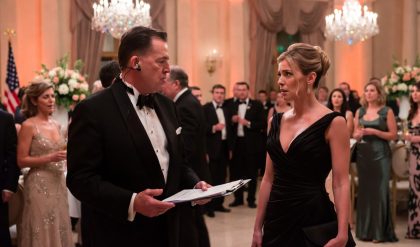
The charity gala was held at the Grand Meridian Hotel in Midtown Manhattan, a palace of marble columns, crystal chandeliers, and old money pretending to be generous. The event raised funds for children’s literacy programs, though half the guests seemed more interested in being photographed beside the donation wall than discussing books. Men in tuxedos laughed over champagne, women in designer gowns floated between tables, and every conversation carried the polished shine of wealth.
Elijah arrived with Greg and Tyler shortly after eight. He looked exactly as people expected him to look: tall, handsome, expensive, and bored. His black tuxedo fit perfectly, his watch cost more than a luxury car, and his smile appeared whenever a camera turned his way.
Greg nudged him near the ballroom entrance. “So, did you invite Rachel?”
Elijah laughed. “No. I may be a jerk, but I’m not suicidal.”
Tyler glanced around the room. “Bet still stands?”
“Of course,” Elijah said. “If Rachel Appleton gets one man to dance with her tonight, I’ll pay you $1,000. But since she won’t even show up, this is free money.”
Greg’s expression tightened. “You know, the more you talk, the worse you sound.”
Elijah lifted a glass of champagne from a passing tray. “Relax. It’s just a joke.”
That was when the room changed.
It happened first as a ripple near the entrance. Conversations slowed. Heads turned. A photographer lowered his camera, then quickly raised it again. Several men near the donation table forgot what they were saying.
Rachel entered alone.
She did not rush, and she did not perform. She simply walked through the ballroom with her shoulders back, her emerald dress catching the light with every step. Her hair framed her face in soft waves, her glasses were gone, and her expression carried the calm dignity of a woman who had stopped asking permission to exist.
Greg’s champagne nearly slipped from his hand.
Tyler whispered, “Who is that?”
Elijah looked toward the entrance, annoyed by the sudden shift in the room. Then he saw her.
For three full seconds, his mind refused to connect the woman in emerald with the secretary outside his office. He saw the elegance first, then the face, then the eyes. The same eyes that had looked at him that afternoon through thick glasses.
His glass stopped halfway to his mouth.
“Rachel?” Greg breathed.
Elijah said nothing.
Rachel moved through the crowd with Moren beside her now, because Moren had slipped in from the side entrance and linked arms with her like a proud accomplice. People stared openly. A board member Elijah had been trying to impress for six months stepped forward and greeted Rachel with visible interest.
“Miss Appleton,” the board member said warmly. “I didn’t realize you’d be attending tonight.”
Rachel smiled. “The company gave senior assistants invitations. I usually decline, but this year felt appropriate.”
The board member laughed. “Well, I’m glad you came. I still remember the crisis plan you organized during last quarter’s software outage. You saved us from a very expensive disaster.”
Elijah heard that from across the room and felt heat rise under his collar. He had taken credit for that crisis response in the executive meeting. Rachel had never corrected him.
More people approached her. Not because they all suddenly knew her, but because confidence attracts attention the way light attracts eyes. Rachel spoke gracefully, with warmth and intelligence. She knew donor names, company details, investor concerns, and charity figures because she had prepared most of the briefing documents herself.
Within fifteen minutes, Elijah watched three men ask her to dance.
She declined the first two politely.
Then Daniel Mercer, a young philanthropist and tech investor from Boston, approached her with a respectful bow of his head. Unlike the others, he did not stare at her as if she were a prize. He spoke to her as if she were a person.
“Miss Appleton,” Daniel said, “I heard your comments about expanding literacy access in rural schools. That was the first real thing I’ve heard in this room all night. Would you honor me with a dance?”
Rachel studied him for a moment, then smiled. “Yes, Mr. Mercer. I would.”
Across the ballroom, Greg slowly turned to Elijah and held out his hand.
Elijah glared at him. “Don’t.”
“A bet is a bet.”
Tyler tried not to laugh. “Pay the man.”
But Elijah barely heard them. Rachel was dancing now, and the room seemed to move around her. She was not flashy. She was not trying to seduce anyone. She was simply present, and somehow that made every cruel word Elijah had spoken feel louder in his own memory.
Ugly and boring.
Grandma clothes.
Bird’s nest.
Zero effort.
The words returned like stones.
For the first time, Elijah wondered not whether Rachel had changed, but whether he had ever looked at her at all.
When the dance ended, Daniel thanked her and stepped away. Rachel turned and found Elijah standing a few feet behind her. He had crossed the room without realizing it.
“Rachel,” he said.
She looked at him calmly. “Mr. Wescott.”
The formality landed harder tonight.
“You look…” He stopped, aware suddenly that any compliment about her appearance would sound cheap after what he had said behind her back. “I didn’t expect to see you here.”
“No,” Rachel said. “I imagine you didn’t.”
Elijah’s throat tightened. “You heard.”
It was not a question.
Rachel held his gaze. “Every word.”
The music continued around them, soft and expensive. Nearby guests laughed, glasses chimed, cameras flashed, but between Rachel and Elijah, the air went still.
“Rachel, I—”
“Don’t apologize here,” she said quietly. “Not where people can see you being noble.”
He flinched.
She stepped closer, her voice still low. “You called me ugly because you thought I couldn’t hear you. You called me boring because I made your life easier without demanding your attention. You turned me into a bet because you confused my silence with weakness.”
Elijah looked ashamed, but Rachel did not stop.
“For three years, I protected your schedule, corrected your mistakes, managed your clients, remembered your mother’s birthday, covered your missed deadlines, and kept your office from falling apart. You praised my work only when it benefited you. But the moment my appearance came up, you laughed like I was a joke.”
His face had gone pale.
“I was wrong,” he said.
“Yes,” Rachel replied. “You were.”
Greg and Tyler had drifted closer, both silent now. Moren stood near the bar watching like a bodyguard in heels. Daniel Mercer also noticed the tension, but Rachel gave him a small nod to show she was fine.
Elijah swallowed. “I’m sorry.”
Rachel looked at him for a long moment. “Are you sorry because I look different tonight, or because what you said was cruel even when you thought I was ugly?”
The question struck him cleanly.
He opened his mouth, then closed it again.
Rachel gave a sad smile. “That’s what I thought.”
She turned and walked away.
The charity program began twenty minutes later. Guests took their seats around white-clothed tables decorated with lilies and gold candles. Elijah sat at the Wescott table, but he could barely focus. Rachel was seated two tables away beside Moren and several board members. Every time someone spoke to her, she listened with calm intelligence, then answered in a way that made people lean in.
Elijah hated how much he had missed.
The foundation director took the stage and thanked the sponsors. Then she announced a surprise segment: a short speech from the person who had coordinated the company’s entire donor outreach campaign, saving the event after a major sponsor withdrew three weeks earlier.
Elijah sat up.
He had assumed they would call his name.
Instead, the director smiled toward Rachel’s table.
“Miss Rachel Appleton, would you please join us?”
Applause rose.
Rachel looked genuinely surprised. Moren grabbed her hand under the table and whispered, “Go.”
Elijah stared as Rachel walked to the stage.
The spotlight found her, and for a moment she looked out over the ballroom. If she was nervous, she did not show it. She placed her hands lightly on the podium and smiled.
“Good evening,” she began. “I was not expecting to speak tonight, so I’ll keep this honest.”
A soft laugh moved through the crowd.
“This gala is about literacy, but literacy is not only about reading words on a page. It is about being able to read the world. To understand contracts, job applications, medical forms, eviction notices, college essays, and the small print that can change a person’s life.”
The ballroom grew quiet.
“Many children never lack intelligence. They lack access. They lack adults who believe their future is worth investing in before they become impressive. That is why tonight matters.”
Elijah listened, stunned by the strength in her voice.
Rachel continued. “And maybe that lesson applies beyond children. Maybe all of us should ask how often we decide someone’s worth before we know their story. How often we dismiss people because of how they dress, where they come from, how quiet they are, or whether they fit our idea of importance.”
Her eyes moved briefly toward Elijah’s table.
His stomach tightened.
“Some people become invisible to survive,” Rachel said. “But invisibility should never be mistaken for emptiness.”
The room erupted in applause before she even finished.
By the time Rachel stepped down, the gala had changed around her. She was no longer Elijah Wescott’s secretary. She was Rachel Appleton, the woman who had held the room in her hand without raising her voice.
After dinner, the foundation held a silent auction. Rachel stood near a display of donated artwork when Elijah approached again, this time without champagne, without arrogance, and without his friends.
“Rachel,” he said. “May I speak to you privately?”
She considered refusing. Then she nodded toward a quiet balcony outside the ballroom. “Five minutes.”
The balcony overlooked Midtown, with yellow taxi lights moving like glowing beads far below. The city air was cool, and Rachel welcomed it after the heat of too many eyes.
Elijah stood beside her, careful not to stand too close. “I don’t deserve five minutes, but thank you.”
“No, you don’t,” she said. “But I’m listening.”
He breathed out slowly. “I was cruel. Not careless. Cruel. And I’ve been trying to tell myself I’m not that kind of man, but tonight made that impossible.”
Rachel said nothing.
“I thought because I respected your work, that was enough. But I didn’t respect you. Not fully. I reduced you to usefulness, then mocked you for not decorating my office with beauty. That was disgusting.”
Rachel looked at him. “Yes, it was.”
He nodded. “I know.”
“Do you?”
“I’m starting to.”
“That’s different.”
He accepted that. “You’re right.”
The honesty surprised her more than she wanted it to.
Elijah looked out over the city. “My father raised me to believe appearances were strategy. The right suit, the right car, the right woman beside you at events. Everything was image. I became good at winning rooms and terrible at seeing people inside them.”
“That may explain you,” Rachel said. “It doesn’t excuse you.”
“I know.”
She studied him under the balcony light. For the first time in three years, he looked less like a millionaire CEO and more like a man forced to meet himself without flattering mirrors.
“I need to ask you something,” she said.
“Anything.”
“If I had arrived tonight exactly as I look at work, thick glasses, baggy sweater, no makeup, would you still be apologizing?”
Elijah’s face changed. That was the question he had been avoiding since she first asked whether he was sorry because she looked different.
He lowered his eyes. “I want to say yes.”
“But?”
“But I don’t know,” he admitted. “And that is the part that scares me.”
Rachel felt something in her chest shift, not forgiveness, but recognition. At least he had told the truth.
“Then start there,” she said. “Start with being scared of the man you became.”
Before Elijah could answer, Greg stepped onto the balcony. He looked uncomfortable but determined.
“Sorry to interrupt,” Greg said. “Rachel, I owe you an apology too.”
Rachel raised an eyebrow.
“I accepted the bet,” Greg said. “I told myself I was proving Elijah wrong, but I still turned you into part of a game. That was wrong.”
Tyler appeared behind him, looking ashamed. “Same here. I didn’t stop it. I laughed. I’m sorry.”
Rachel looked at the three wealthy men standing before her like schoolboys outside a principal’s office. It would have been funny if it had not been so sad.
“You all treated my dignity like entertainment,” she said.
Greg nodded. “We did.”
Tyler reached into his jacket and pulled out an envelope. “The $1,000 from the bet. Greg won it. We talked, and we want to donate it to the literacy foundation in your name.”
Rachel looked at the envelope, then back at them. “Make it $10,000 each.”
Tyler blinked. “Each?”
Rachel smiled politely. “You’re all CEOs, aren’t you? Surely dignity is worth more than $1,000.”
Greg’s face broke into a grin. “Fair.”
Elijah did not hesitate. “Done.”
Rachel folded her arms. “And not in my name. In the name of every woman in your companies who has ever had to become smaller to be taken seriously.”
For once, none of them had a clever answer.
The donation was made before midnight.
But Rachel was not finished.
On Monday morning, she arrived at work exactly as she had for years: thick glasses, baggy cardigan, hair tied back, no makeup. The difference was that the disguise no longer felt like hiding. It felt like a choice.
The office reacted strangely.
People who had ignored her for years suddenly greeted her with bright smiles. Men who had never remembered her name now offered coffee. Women from other departments stopped by her desk and whispered that her speech had been incredible. A few even said they had cried.
Elijah stepped out of his office at nine sharp.
He saw Rachel at her desk and paused. She looked like the Rachel he had always known, but now he understood that he had never known her at all.
“Good morning, Miss Appleton,” he said.
She glanced up. “Good morning, Mr. Wescott.”
He placed a folder on her desk. “I reviewed the donor report. Your work was outstanding. I should have said that often and publicly.”
Rachel said nothing.
“I’m also scheduling a company-wide review of promotion pathways for administrative staff,” he continued. “Too many people here carry executive-level responsibility without executive-level recognition.”
That caught her attention.
He looked directly at her. “Including you.”
Rachel removed her glasses slowly. “Is this guilt?”
“No,” Elijah said. “It started with guilt. Then I read the last three years of your work.”
Her expression remained guarded.
“You built client retention systems, corrected legal filing errors before they became penalties, managed investor communications, and prepared half the strategy documents I presented as if I created them alone. You have been operating above your title for years.”
“Yes,” Rachel said. “I have.”
“I want to promote you to Director of Executive Operations.”
The office around them went quiet.
Rachel leaned back in her chair. “And if I say no?”
“Then I’ll ask what role you actually want and help build a path to it.”
That answer surprised her.
She studied him for any sign of performance, but for once Elijah did not look like a man trying to win approval. He looked like a man trying to repair something knowing he might not be allowed to.
“I’ll consider it,” Rachel said.
“That’s all I can ask.”
“No,” she said. “You can ask less. I’ll tell you when I’m ready.”
A faint smile crossed his face. “Understood.”
Over the next three months, Elijah changed in ways that were too consistent to dismiss as embarrassment. He stopped interrupting women in meetings. He credited Rachel’s work by name. He corrected other executives when they judged junior staff by appearance or background. He created a formal leadership track for assistants, analysts, coordinators, and office managers who had long been treated as invisible labor.
Some people said he was only doing it because Rachel humiliated him.
Rachel did not care why people started doing the right thing, as long as they kept doing it when applause disappeared.
She accepted the Director of Executive Operations role after negotiating her salary herself. Elijah offered $145,000. Rachel calmly slid a market analysis across his desk and asked for $185,000, plus performance bonus eligibility and a seat in quarterly strategy meetings.
Elijah stared at the document, then laughed softly.
“What?” Rachel asked.
“I was about to say you drive a hard bargain,” he said. “Then I realized you simply came prepared.”
“Yes,” Rachel replied. “I usually do.”
He signed the revised offer.
Rachel moved into an office with a door and a window overlooking the city. She kept her thick glasses on her desk beside her laptop, not because she needed them, but because they reminded her of the years she survived by being unseen. She did not hate that version of herself anymore. That Rachel had protected her until she was ready to stop hiding.
One evening, months after the gala, Elijah found her still working after seven. Most of the office had emptied, and the city lights glowed beyond the windows.
“You should go home,” he said from her doorway.
“So should you,” Rachel replied without looking up.
“I probably deserve that.”
“You definitely do.”
He smiled slightly. “Daniel Mercer called again.”
Rachel’s pen paused. “Did he?”
“He wants to discuss a partnership between his foundation and our internship program.”
“That sounds professional.”
“It does,” Elijah said, though something in his tone revealed more than professionalism.
Rachel looked up, amused. “Are you jealous, Mr. Wescott?”
He froze. “No.”
She waited.
He sighed. “Possibly.”
Rachel laughed, and the sound surprised both of them. It was warm, unguarded, and nothing like the quiet woman Elijah had once mistaken for boring.
He leaned against the doorframe. “I know I have no right.”
“You don’t.”
“I know.”
“And jealousy is unattractive.”
“I’m discovering many unattractive things about myself.”
“At least you’re busy.”
He laughed this time.
The truth was that something had changed between them, but Rachel refused to romanticize it too quickly. She knew how easily powerful men could confuse admiration with desire once a woman became visible. She also knew forgiveness was not a door that opened just because someone knocked with flowers.
Elijah seemed to understand that. He never pushed. He never asked her out. He never turned his apology into a demand for emotional reward. He simply kept becoming better in front of her, day after day, whether she praised him or not.
A year after the gala, the literacy foundation invited Rachel to speak again. This time, she attended not as Elijah’s secretary, not as a surprise guest, and not as a woman proving a point. She attended as Director of Executive Operations and founder of Wescott Group’s Invisible Talent Initiative, a program that had already promoted thirty-seven overlooked employees into leadership positions.
She wore a midnight blue dress, her hair down, her glasses on.
When she entered the ballroom, people still turned to look. But this time, Rachel did not wonder whether they saw beauty, power, or transformation. She did not need their interpretation. She knew who she was.
Elijah stood near the donation wall speaking to Greg and Tyler. All three men stopped when they saw her.
Greg grinned. “I’m not making any bets tonight.”
“Smart,” Rachel said.
Tyler lifted both hands. “I have learned fear and respect.”
“As you should,” she replied.
Elijah smiled, but there was humility in it now. “You look beautiful, Rachel.”
She looked at him carefully.
Then he added, “And you looked beautiful last Monday in that oversized gray cardigan when you told the CFO his budget assumptions were ridiculous.”
Rachel’s mouth twitched. “They were ridiculous.”
“They were,” he agreed.
That was the first compliment from him that did not feel like a trap.
Later that night, after Rachel’s speech received another standing ovation, Elijah found her near the balcony where they had spoken one year earlier. The same city shimmered below them, but both of them were different now.
“I owe you something,” he said.
Rachel smiled. “Another apology?”
“Always. But not only that.”
He reached into his jacket and pulled out a small folded note. “This is the first note I wrote after last year’s gala. I never gave it to you because it sounded like I wanted forgiveness too quickly.”
Rachel took it.
Inside, written in Elijah’s precise handwriting, were three sentences.
I did not fail to see Rachel because she was invisible. I failed because I was blind. If she ever trusts me again, I want to deserve it before I ask for it.
Rachel read the note twice.
When she looked up, Elijah was not smiling.
“I’m not asking for anything,” he said. “I just wanted you to know that the night changed me before anyone applauded me for changing.”
Rachel folded the note slowly. “Good.”
They stood in silence for a while.
Then she said, “Coffee.”
He blinked. “What?”
“You may ask me to coffee,” Rachel said. “One coffee. Public place. No expensive restaurant. No dramatic gestures. No assuming it means more than coffee.”
Elijah’s face lit with careful hope. “Rachel Appleton, would you like to have coffee with me sometime?”
She pretended to consider. “I’ll check my schedule.”
“You control my schedule too.”
“Exactly,” she said. “So behave.”
He laughed softly. “Yes, ma’am.”
Their coffee happened two weeks later at a small café in Brooklyn where no one cared about Elijah’s last name. Rachel wore jeans and a soft sweater. Elijah wore a simple jacket instead of a suit. They talked about books, work, childhood, fear, ambition, and the strange loneliness of being admired for the wrong things.
There was no fairy-tale ending that day. Rachel did not suddenly fall into his arms. Elijah did not become perfect because one woman challenged him. Life was more complicated than that, and Rachel respected herself too much to confuse progress with redemption.
But there was a beginning.
A real one.
Years later, people in the company still talked about the gala. New employees heard different versions of the story: the millionaire who bet against his “ugly” secretary, the woman who arrived and silenced the room, the speech that changed promotion policies, the donation that began a foundation partnership.
Rachel always corrected one part.
“I did not become valuable when I walked into that ballroom,” she would say. “I was valuable when I was sitting at that desk being ignored.”
And that became the lesson no one forgot.
Beauty had stunned the room for one night.
But dignity changed the company.
And Rachel Appleton, the woman who once made herself invisible to survive, became impossible to overlook not because she took off her glasses, wore a beautiful dress, or proved a cruel man wrong.
She became impossible to overlook because she finally stopped hiding from people who had never been worthy of deciding her worth in the first place.