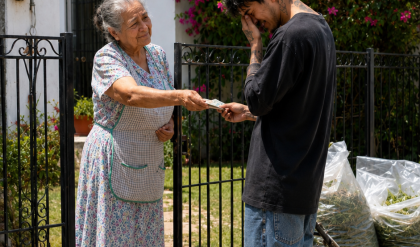
The voice was so quiet that Marcus Reed almost didn’t hear it because of the noise from the grill.
It was early morning in Los Angeles, and the city was already buzzing with activity. Cars rolled endlessly through the streets, buses sighed and stopped at crowded corners, and office workers hurried past, oblivious to the small burger truck parked under a faded red parasol near Wilshire and Vermont.
Almost no one noticed the little boy who was standing there.
Marcus looked up from the grill and saw a child who couldn’t have been more than nine years old. He was shockingly thin and wore an oversized, brown, dirt-stained hoodie. A huge plastic bag full of crushed cans hung heavily from his shoulder. His sneakers were ripped at the seams, and the laces that held them together looked as if they had been patched together from scraps of fabric.
The boy slowly opened his trembling hand.
A few coins lay in the palm of his hand.
One-cent coins. Five-cent coins. A quarter dollar.
“Could I afford the cheapest burger?” he asked quietly.
Marcus looked at the coins, then at the child’s face. Even the cheapest dish on the menu cost more than what the boy was holding, and Marcus remained silent for several long seconds, because the truth was complicated. Compassion had become expensive lately.

At 67, Marcus was fighting for survival. Arthritis made his hands stiff every morning, overdue bills piled up next to the cash register, and the old food truck was the only thing keeping him from ruin. The rent kept rising, medical expenses steadily increased, and some mornings he seriously wondered how much longer his body could take it.
The practical answer would have been simple.
Not today.
I can’t afford that.
But then Marcus noticed the boy staring at the burgers sizzling on the grill . It wasn’t greed or curiosity. It was desperation—the quiet kind of desperation that comes from real hunger. Marcus recognized it immediately, because years before he had seen the same expression in the mirror.
Luxury car rental
Without another word, Marcus gently closed the child’s fingers around the coins again.
“Keep your money,” he said.
Then he turned to the grill and prepared a fresh burger with fries. He took his time, as one does when showing someone affection without embarrassing them. When he finally handed the warm package to the child, it stared at it in disbelief as steam rose into the cool morning air.
“Really?”, he whispered.
Marcus smiled weakly.
Car care tips
“Eat. You don’t owe me anything.”
The boy sat quietly beside the cart and ate slowly, almost deliberately, as if he wanted to savor the feeling of fullness for as long as possible. Before he left, he looked at Marcus with tears in his eyes and said something that Marcus would remember for years to come.
“I will never forget that.”
Then he disappeared into the crowd.
Life went on after that. Every morning before sunrise, Marcus unlocked his car and endured the heat, exhaustion, and loneliness as the city around him changed. Glass towers replaced old buildings, rents rose, and his small burger stand aged with him. But he often thought of the boy who had collected scrap metal and wondered what had become of him.
Burger
Twenty-five years passed.
But then, one morning, as Marcus was standing behind the shopping cart, staring at the payment reminders and wondering if he was about to lose everything for good, an elegant black luxury car pulled up to the sidewalk.
The people nearby slowed their pace and stared.
Such cars never stopped near his car.
The back door opened, and a tall man in an expensive black suit stepped out. He looked well-groomed, successful, influential – like someone who belonged in skyscrapers and boardrooms, not next to a dilapidated food truck with peeling paint.
But the moment the man looked at Marcus, something changed in his facial expression.
Emotions shattered self-confidence.
He walked slowly towards the shopping cart, as if each step carried years of memories, then stopped directly in front of Marcus and carefully placed a leather folder on the counter.
Marcus frowned in confusion.
“Can I help you?”
The man smiled gently.
“I came back because of you.”

And suddenly Marcus recognized the eyes.
The same eyes that once regarded a burger as salvation.
His breath caught in his throat.
“You are Ethan?”
The man nodded.
“Yes, sir.”
For a moment, Marcus could barely speak. Twenty-five years earlier, he had simply fed a starving child because he couldn’t bring himself to turn him away. He had never expected gratitude. Never anything in return. He had only hoped the boy would survive.
But now survival lay before him, in a tailor-made suit that was worth more than Marcus had earned in months.
Ethan soon revealed to Marcus the truth he had never known. That day, after he’d left the shopping cart, he didn’t know where to go. His mother had disappeared months earlier, he’d never met his father, and he’d been sleeping behind a recycling center and collecting cans just to buy food.
“This burger didn’t just feed me,” Ethan admitted quietly. “It triggered something in me that I didn’t know how to deal with.”
Marcus could barely hold back his tears.
But Ethan’s return wasn’t just about gratitude.
Over the years, Ethan had built a huge food distribution business and become one of the most successful businessmen in Los Angeles. But during his research into nonprofit food programs, he discovered that developers were secretly trying to drive Marcus and dozens of other street vendors out of the neighborhood through fake ads and legal pressure.
That’s why Ethan came back.
Not only to save Marcus’s cart, but to protect every single struggling trader who is quietly disappearing from the city.
The leather folder contained legal documents, evidence against the developers, and plans for something called The Marcus Reed Community Food Trust – a project that aimed to create protected food spaces, mobile kitchens, youth programs, and support systems for vulnerable families throughout Los Angeles.
Food delivery service
Marcus stared at the papers in disbelief.

“You named it after me?”
Ethan nodded.
“Because all of this began here.”
At first, Marcus resisted. He wanted neither charity nor pity nor attention. But Ethan made it clear to him that this wasn’t about rescue, but about a partnership. He wanted to include Marcus because, as he quietly explained, successful leaders understood systems, but Marcus understood hunger.
This difference was significant.
Later that day, they stood together at a city hearing, where Ethan exposed the fraudulent campaign against local businesses, while Marcus spoke candidly about what it meant to feed people for decades whom society preferred to ignore. His speech was neither polished nor dramatic, but it conveyed something more powerful than any performance—the truth.
“I used to think I was just selling burgers,” Marcus told those present. “But maybe I kept a small part of the world open for people who needed a place where they didn’t have to be ashamed.”
Then there was silence in the room.
At the end of the hearing, the city froze the zoning plan and agreed to negotiate protective measures for local businesses through Ethan’s foundation. It wasn’t a complete victory, but for the first time in years, Marcus no longer felt invisible.
Back at the food truck, Ethan stood once again on the customer side of the counter, exactly where he had stood decades before as a hungry child. Marcus slowly prepared another burger, wrapped it carefully, and handed it over the counter.
“This is on the house,” he joked quietly.
Ethan smiled through his tears.
“No,” he replied gently. “This time let me pay.”
And for a brief moment, as they stood beneath the faded umbrella while the city endlessly revolved around them, the old man and the boy he had once fed finally understood something that neither of them had been fully aware of before:
Kindness doesn’t disappear in an instant.
Sometimes it simply travels silently through time… until it finds its way home again.